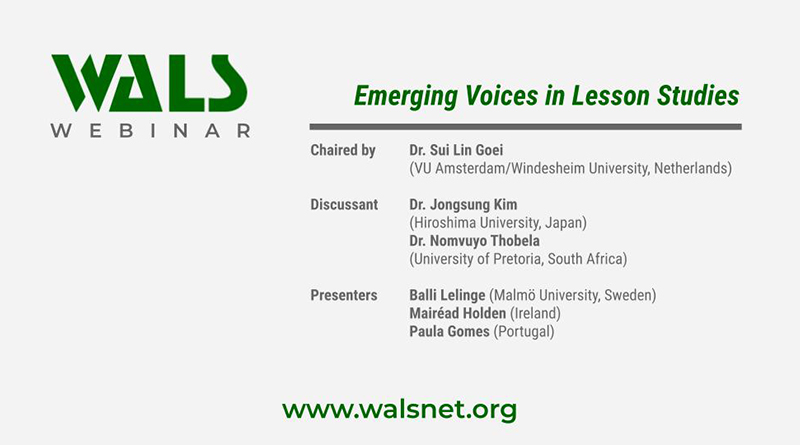
Emerging Voices in Lesson Studies
Date and Time
8th April 2023
06:00 San Francisco
15:00 Central European Time
19:00 Kazakhstan
21:00 Singapore
22:00 Tokyo
About this Webinar
Chair: Dr. Sui Lin Goei (VU Amsterdam/Windesheim University, Netherlands)
Discussiant: Dr. Jongsung Kim (Hiroshima University, Japan) & Dr. Nomvuyo Thobela (University of Pretoria, South Africa)
Lesson Study has also grown in popularity as a research topic and as research methodology among doctoral students and early career researchers (ECR). This webinar ‘Emerging Voices in Lesson Studies’ is organized by the WALS Phd and Early Researchers committee and will focus specifically on studies by emerging researchers in Lesson Studies. The presentations are a reflection of the collection of papers published in the Special Issue of the International Journal of Lesson and Learning Studies to be published in March 2023. The Special Issue will feature research from Balli Lelinge from Sweden, Rachel Goh from Singapore, Mairead Holden from Ireland, Paula Gomes from Portugal, and Linda Cardoso also from Portugal. In the webinar three of these authors, Balli, Mairead and Paula, will present their work. The studies will be discussed by Dr. Jongsung Kim from Hiroshima University and a Phd student Nomvuyo Thobela. The WALS Phd/ECR committee wishes that the Special Issue and this webinar will serve as a stimulus and motive for Phd and ECR to publish their (on)going work and will also serve as a model for their peers in academia, schools and other contexts.
You can find the abstracts of the papers and bio’s of the presenters here:
Predicting challenges to student learning in a learning study: Analysing the intended object of learning
Balli Lelinge (Malmö University, Sweden)
The purpose of this study is to understand how the intended object of learning, as planned by teachers, is perceived by students. This is done through a learning study, in which the intended, enacted, and lived object of learning are all considered. The study specifically focuses on the learning material used by teachers in the design of a lesson. The data for the study consists of a lesson on enhancing primary school students’ dancing skills in the subject of Physical Education and Health, using a video-recorded dance choreography. The choreography consists of several sequences that build on each other and act as building blocks for students to transition between movement patterns. The results of the study show how an analysis of learning material based on variation theory can help teachers consider the complexity of the object of learning and identify which parts of the lesson may be more challenging for students with different educational needs. This research adds to the field by highlighting the potential of using theoretical assumptions in lesson design to enhance classroom learning and guide teachers in meeting the needs of their students.
Balli Lelinge has a PhD in pedagogy, particularly interested in special didactic against teaching, content inclusion and classroom methods. He is a university lecturer at Malmö University in Sweden. His thesis is titled “Collaborative professional development for content inclusive education.” He received a licentiate degree in pedagogy in 2010 at Malmö University titled Class Council – a social space for democracy and education (Lelinge, 2011). His current research field is collaborative professional development (CPD) for content-inclusive education, which takes practice-based professional development (PBPD) as its point of departure. He is interested in how the community of practice can be understood as an essential aspect of developing an inclusive and accessible learning environment from the teachers’ perspective regarding the school’s social context and the treatment of the content knowledge.
Exploring online lesson study as a vehicle for teacher collaborative professional learning
Mairéad Holden (Ireland)
PhD student Mairéad Holden from Ireland takes an original approach in her paper on Online Lesson Study as a vehicle for teacher collaborative professional learning, with a specific focus on Science, Technology, Engineering, and Mathematics (STEM) education. Online Lesson Study recently sparked the interest of various Lesson Study researchers (e.g., Goei et al., 2021), mostly due to the Covid-19 pandemic. As such, Mairéad’s study is adding to a new perspective on Lesson Study that explorers how Lesson Study takes place in an online environment, having to deal with so-called ‘digital boundary objects’. Mairéad followed two parallel online Lesson Study cycles in two teams, which were facilitated by herself using various digital collaborative tools. The results show how teachers gained new understanding of inquiry-based pedagogies in STEM, enabling students to uncover new knowledge themselves as opposed to being a mere recipient of knowledge delivered by a teacher. Another interesting finding is that teachers noted the importance of incorporating adaptive teaching practices in STEM to meet their students’ educational needs. However, limited evidence is provided of specific STEM content knowledge development amongst the teachers who participated and this may therefore offer interesting opportunities for follow-up studies by anyone interested in online Lesson Study.
Mairéad Holden is a primary teacher and teacher educator. She currently holds the role of Teacher Fellow in the School of STEM Education, Innovation and Global Studies in the Institute of Education in Dublin City University, Ireland. She is completing her Ph.D. research in the University of Lincoln, United Kingdom, focusing on the use of Online Lesson Study (OLS) as a vehicle for teacher collaborative learning in STEM. In addition to examining teacher learning outcomes and processes arising from OLS, her thesis draws on a self-study approach to reflect on her experience leading the first OLS ever conducted in Ireland.
Leading whole-class discussions: from participating in a lesson study to teaching practice
Paula Gomes (Portugal)
This article examines how participation in lesson studies influences a secondary school mathematics teacher’s ability to lead whole-class discussions. The research is qualitative and interpretive, and data was collected through participant observation, audio recordings of lesson study sessions, semi-structured interviews, and video recordings of lessons. The results suggest that the teacher’s participation in lesson studies influenced her teaching practice in several ways, including her ability to guide students through explanations of their strategies, challenge them to justify their ideas, explore incorrect strategies and disagreements, and involve students in drawing connections. The teacher also noted that participating in lesson studies allowed her to rethink her practice and gain a new perspective on leading discussions that actively engage students in learning mathematics.
Paula Gomes is a secondary school mathematics teacher and a PhD student at Instituto de Educação, Universidade de Lisboa. She is in the final stage of her PhD, focusing on the development of secondary school mathematics teachers’ knowledge and teaching practice while participating in lesson study, and the influence that such participation has on their later teaching practice
Bio Dr. Jongsung Kim
Jongsung Kim is an Associate Professor at Hiroshima University, where he teaches social studies methods courses and runs international research projects and student exchange programs. As a Korean “stranger” (Simmel, 1950) in a Japanese classroom, he explores the hidden features of Japanese education, which includes social studies education, citizenship education, and lesson study, and shares them with educators outside of Japan. He co-edited Lesson Study-based Teacher Education: The Potential of the Japanese Approach in Global Settings and Design Research in Social Studies Education: Critical Lessons from an Emerging Field.
Bio Dr. Nomvuyo Thobela
Nomvuyo Maureen Thobela is a South African mathematics subject advisor in the Intermediate Phase (grade 4 – 6) and Senior Phase (grade 7 – 9). Her interest is on mathematics instructional methodologies that promote both learner and teacher learning. She was inspired by the teaching model – Lesson Study (LS) that she got to learn about when she visited Japan in 2017. On her return, she started implementing LS in her district while she also enrolled as a student at the University of Pretoria researching on Mathematics teacher’s engagement with the textbook: the affordances of Lesson Study. She has just completed her PhD and will be graduating this year. She is also a member of the PhD and ECR committee whose task is to create a LS global community. She has recently facilitated a successful LS café on mathematics textbooks.